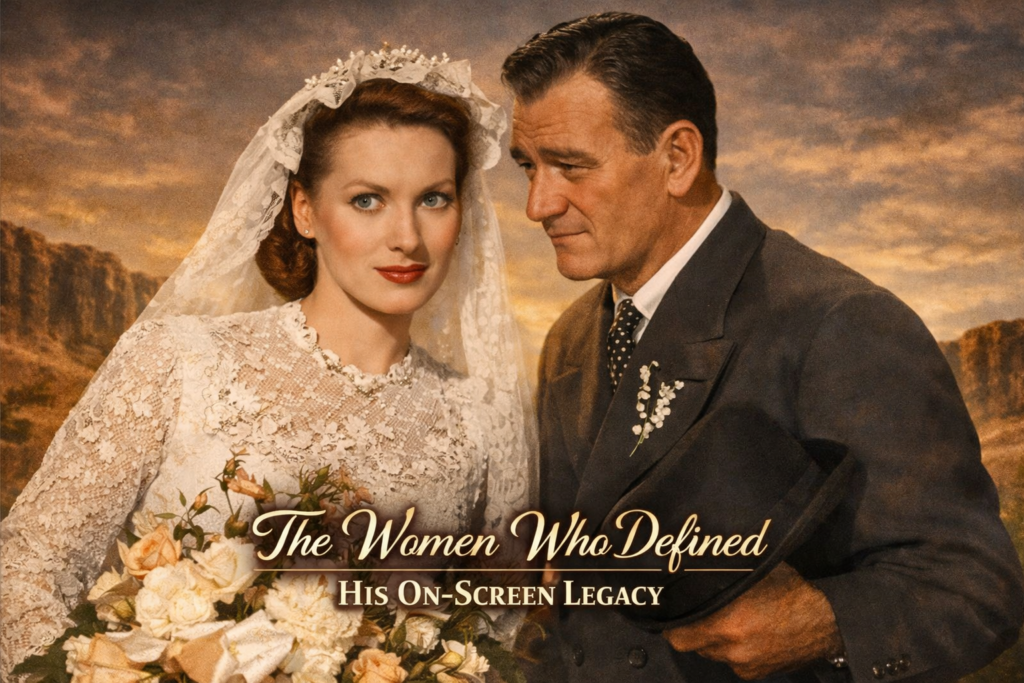
The enduring image of John Wayne, the rolling gait, the weathered Stetson, and the measured, gravelly drawl, is the definitive architecture of American masculinity in the twentieth century. Yet, to view “The Duke” as a solitary monument of rugged individualism is to ignore the essential scaffolding that supported his mythic status. His career, spanning over fifty years and nearly two hundred films, was a continuous dialogue with a series of formidable leading ladies who challenged, softened, validated, and occasionally outshone him.1 These women were not mere decorative counterpoints to his machismo; they were the catalysts who transformed a B-movie cowboy into a cultural icon. From the world-weary grit of Claire Trevor to the fiery independence of Maureen O’Hara and the regal dignity of Lauren Bacall, the women who shared the screen with Wayne provided the emotional depth necessary to make his “100 percent man” persona relatable to global audiences.1
The fascination with Wayne’s leading ladies stems from a unique alchemy of on-screen chemistry and off-screen intrigue. In the high-pressure environment of the Hollywood Studio System, the lines between professional collaboration and personal passion were frequently blurred.6 Rumors of secret affairs, documented tensions on set, and lifelong friendships that survived the rigors of the industry create a rich tapestry of human experience beneath the cinematic surface.3 By examining the women who defined his legacy, we uncover a more nuanced John Wayne, a man who was a “re-actor” as much as an actor, thriving most when paired with a woman of equal “hell and fire”.5
The Women Behind The Duke’s Greatest Films
The evolution of the John Wayne persona can be traced through the changing archetypes of his female costars across different phases of his career. In the early stages, particularly following the breakthrough of Stagecoach (1939), his leading ladies were tasked with grounding his burgeoning sex appeal and establishing his moral compass.1 Claire Trevor, a versatile and gifted actress, played a pivotal role in this formative period. Making three films with Wayne, Stagecoach, Allegheny Uprising, and Dark Command, Trevor provided a blend of toughness and vulnerability that matched the Ringo Kid’s own mix of innocence and lethal skill.1 Her portrayal of Dallas in Stagecoach was a statement against class prejudice, representing the “good-hearted fallen woman” who recognized the inherent nobility in Wayne’s character.12
| Actress | Phase of Career | Key Film Influence | Impact on Image |
| Claire Trevor | Early (1930s-40s) | Stagecoach | Established his romantic appeal and moral vulnerability. 1 |
| Marlene Dietrich | Middle (1940s) | Seven Sinners | Contrasted his awkwardness with worldly sophistication. 1 |
| Gail Russell | Middle (1940s) | Angel and the Badman | Highlighted a tender, protective, and introspective side. 15 |
| Maureen O’Hara | Peak (1950s-70s) | The Quiet Man | Validated him as a man who could meet his match in strength. 5 |
| Angie Dickinson | Late (1950s-60s) | Rio Bravo | Revitalized his sex appeal in a mature, flirtatious context. 18 |
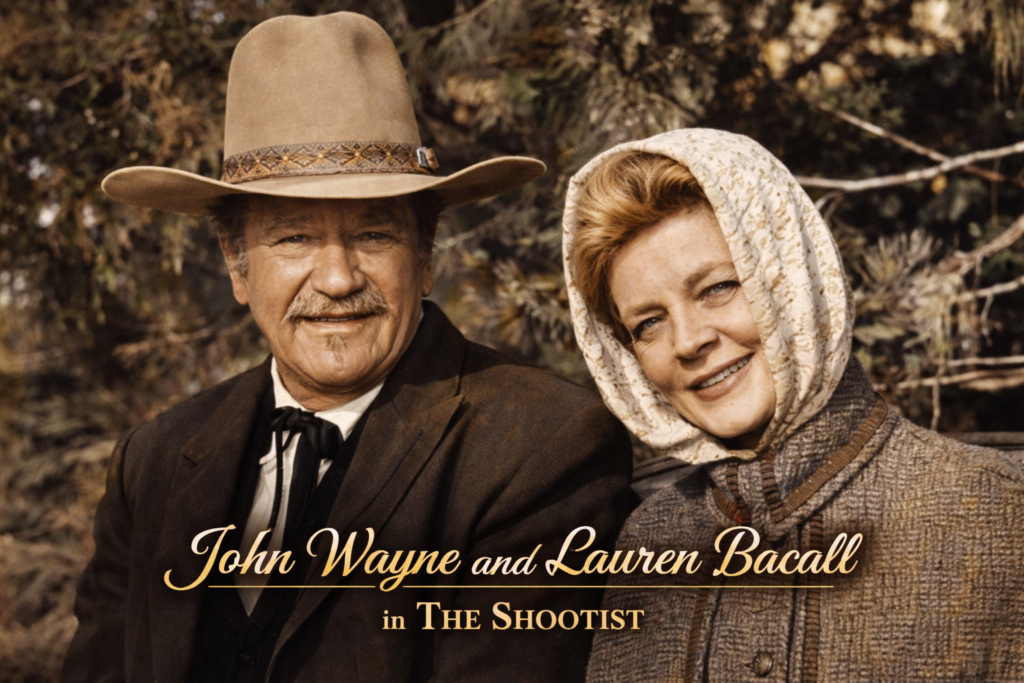
| Lauren Bacall | Final (1950s-70s) | The Shootist | Represented the ally and the dignified final companion. 4 |
The necessity of a strong leading lady in a John Wayne film was not merely a matter of romantic interest; it was a structural requirement for his character’s development. Director Howard Hawks, a frequent collaborator, observed that Wayne’s romantic effectiveness was highest when the female lead was “forcing the issue”.20 Unlike stars like Clark Gable, who were often the primary aggressors in love scenes, Wayne flourished when paired with women who possessed their own agency and resolve.20 This led to the rise of the “Hawksian woman” tough, fearless, and capable of standing “toe-to-toe” with any man.15 Joanne Dru’s performance in Red River (1948) exemplifies this, as her character Tess Millay remains unruffled even when wounded by an arrow, proving she is as durable as the men on the cattle drive.15
Without a “steel magnolia” like Vera Miles in The Man Who Shot Liberty Valance (1962) or The Searchers (1956), Wayne’s characters risked becoming monolithic symbols of violence.15 The presence of a woman with “heroic levels of loyalty and resolve” provided the moral weight for the Duke’s actions, turning his gunfights into defenses of civilization and his stubbornness into a virtue of protection.3
The Perfect On-Screen Partner: Who Matched Him Best
Determining who matched John Wayne best on screen requires an analysis of varying styles of chemistry. While several actresses left an indelible mark, the consensus among critics, fans, and the Duke himself often points toward a few specific names who transcended the standard leading lady role.1 The intensity of the “on-screen match” was frequently measured by how much the actress could challenge Wayne’s dominance without diminishing his stature.5
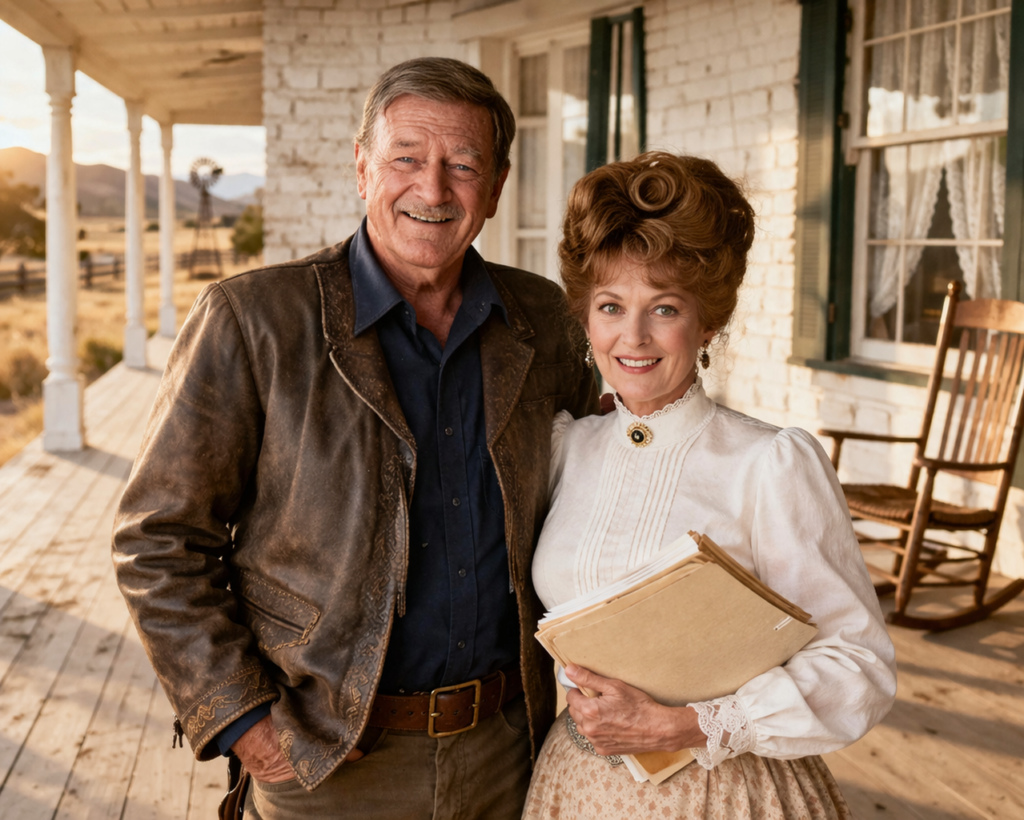
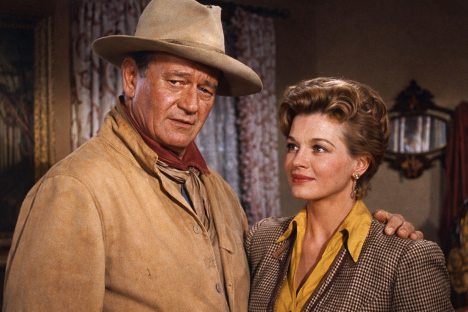
Maureen O’Hara is widely regarded as his most compatible partner. Their chemistry was built on a foundation of mutual physical and emotional strength.9 O’Hara famously stated that she was “the only leading lady big enough and tough enough for John Wayne”.5 This “electric” connection was not based on submissiveness but on a “hell and fire” that suggested the two characters were true equals.5 Their scenes together, particularly in the works of director John Ford, often resembled a dance of two titans, where Wayne’s “taming” of O’Hara was only ever a temporary and mutually agreed-upon illusion.5
In contrast, Wayne’s chemistry with Angie Dickinson in Rio Bravo (1959) represented a different kind of success. Despite a 24-year age gap, the pair shared a “surprisingly warm romantic chemistry” that felt authentic and flirtatious.18 Wayne himself was exceptionally impressed by Dickinson, praising her for having “beauty, sex appeal, and brains” and calling her one of the best actresses he ever worked with.18 Dickinson’s character, Feathers, brought out a playful, almost “adorable” side of the Duke that was rarely seen in his more austere Westerns.18
Later in his career, Wayne found a unique match in Katharine Hepburn. While they only appeared together once in Rooster Cogburn (1975), the film was a “happy marriage of convenience” between two aging legends.26 Their chemistry was described as a “mutual admiration society,” with the bickering between Hepburn’s spinster Eula Goodnight and Wayne’s cantankerous marshal providing the film’s primary charm.26 Unlike the fiery passion of the O’Hara years, the Wayne-Hepburn dynamic was one of shared history and “sheer acting craft,” where two icons recognized each other as the last of their kind.27
Comparing the Dynamics of Key Costars
The archetypes of Wayne’s leading ladies can be categorized by the specific way they interacted with his “Duke” persona:
- The Equal (Maureen O’Hara): The “Titan” dynamic. Best for epic romances and domestic dramas where Wayne’s masculinity needed a mirror of equal strength.5
- The Sophisticate (Marlene Dietrich): The “Culture Clash” dynamic. Contrasted Wayne’s shyly awkward men with worldly, sophisticated women.1
- The Vulnerable Muse (Gail Russell): The “Protector” dynamic. Brought out a mystical, introspective, and gentle side of the Duke.15
- The Respected Ally (Lauren Bacall): The “Professional” dynamic. In Blood Alley and The Shootist, Bacall provided a sophisticated, unwavering presence that didn’t require romance to be effective.4
- The Independent Spirit (Angie Dickinson): The “Playful” dynamic. Bridged the age gap with intellect and sex appeal, challenging the Duke’s authority with wit.18
The common thread among these women was their ability to project “It”—a particular female strength rarely seen onscreen outside the Western genre.15 This strength allowed them to stand “toe-to-toe” with Wayne, ensuring that the emotional stakes of the film remained as high as the physical action.11
Maureen O’Hara and John Wayne: A Bond Beyond The Screen
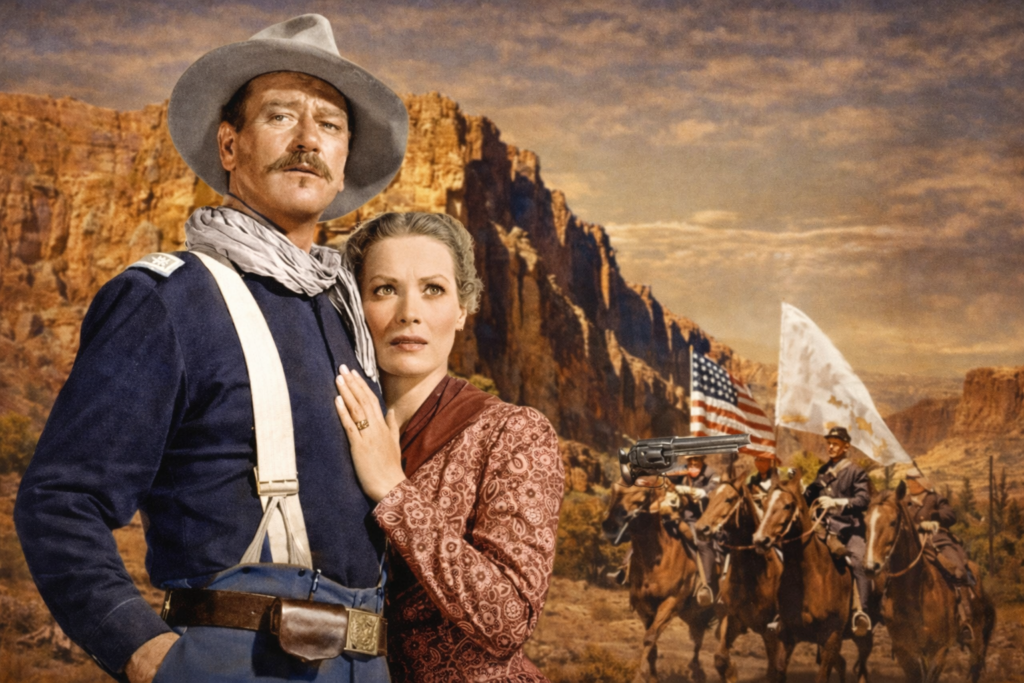
The relationship between John Wayne and Maureen O’Hara is perhaps the most celebrated friendship in Hollywood history, spanning 39 years and five feature films.9 Their collaboration began with Rio Grande (1950) and reached its artistic zenith with The Quiet Man (1952), a film that remains a touchstone of Irish-American cinema.3 To the public, they were the quintessential on-screen couple, leading many to assume they were married in real life.32 However, the reality of their bond was more complex, a deep, platonic “brother and sister” relationship characterized by loyalty, shared secrets, and a unique professional rapport.1
Wayne often spoke of O’Hara in terms usually reserved for his closest male friends, describing her as “the greatest guy I ever knew” and “a big, lusty, wonderful gal”.1 This high praise reflected Wayne’s preference for the company of men, with O’Hara being the rare exception who could survive his “tough” world and match his energy.5 On set, their communication was almost telepathic; they had their own “language” and could anticipate each other’s moves without direction.17 This was evident in the physical intensity of their films, such as the famous scene in The Quiet Man where Wayne’s Sean Thornton drags O’Hara’s Mary Kate Danaher across the fields, a scene performed without stunt doubles.5
The Rumor Mill vs. The Reality of the O’Hara Affair
Despite their insistence on a purely platonic friendship, persistent rumors of a “long-term romance” have haunted their legacy.34 Biographers and close associates have offered conflicting accounts of the nature of their relationship.
| Claim | Source/Context | Evidence/Counter-Evidence |
| Long-term Affair | Scott Eyman’s “John Wayne: The Life and Legend” | Claims from a “close friend” of Wayne; alleged secret meetings at his Arizona ranch.3 |
| True Love | Christopher Mitchum (son of Robert Mitchum) | Claimed Wayne was “truly in love” with O’Hara but married women he could “control” instead.3 |
| Platonic Friendship | Maureen O’Hara’s memoirs and interviews | Consistent denials of romance; shared friendship between Wayne and O’Hara’s husband, Charles Blair.3 |
| Secret Love Poems | “Maureen O’Hara’s Family Finally Reveals” (YouTube) | Claims of 17 secret love poems and a hidden photo by Wayne’s bed for 30 years.34 |
| “Auntie Maureen” | John Wayne’s children | The Duke’s children reportedly called her “Auntie Maureen,” suggesting a family-like bond.9 |
The depth of their connection was most visibly demonstrated during Wayne’s final illness. Knowing he was dying, O’Hara flew to Washington D.C. to testify before a Congressional subcommittee, urging them to strike a gold medal in his honor.9 Her statement that “John Wayne is the United States of America” remains the definitive eulogy for the actor.9 When Wayne passed away in 1979, O’Hara was reportedly the only person whose grief was truly inconsolable, marking the end of a partnership that many believe “sits quietly between” friendship and love.5
Rumors, Romance, and Hollywood Whispers
While the O’Hara relationship remains a subject of debate, John Wayne’s life was undeniably punctuated by a series of documented affairs and scandalous rumors that stood in stark contrast to his public image as a paragon of traditional morality.3 Wayne was married three times, to Josephine Saenz, Esperanza “Chata” Baur, and Pilar Palette, yet he was “habitually unfaithful,” leading to a personal life that many biographers describe as tumultuous.3
The most prominent of these affairs was with the legendary Marlene Dietrich. The two met in 1940 on the set of Seven Sinners, and the attraction was immediate.6 Dietrich, already a global superstar, personally selected Wayne as her leading man, engineering their meeting in the Universal commissary.6 Their relationship lasted on and off for several years, with Dietrich acting as a “tough and down-to-earth” companion who matched Wayne’s interests in hunting and fishing.1 Wayne was reportedly enchanted by her glamour but was ultimately unwilling to leave his family for her, leading to an amicable fading of their liaison.6
Another significant and more tragic scandal involved Gail Russell. During the filming of Angel and the Badman (1947), rumors of an affair between the 40-year-old Wayne and the 23-year-old Russell became so intense that they nearly ended Wayne’s second marriage.16 His wife, Chata Baur, was notoriously jealous and reportedly waited for him with a gun, nearly shooting him when he returned home late from a party with Russell.8 While both Wayne and Russell denied the affair under oath during Wayne’s divorce proceedings, local witnesses at the time claimed to have seen them “holding hands and smooching” in the Cottonwood Hotel corridor.35 Regardless of the romantic truth, Wayne remained a lifelong protector of the “painfully shy” Russell, giving her roles in later films as she struggled with the alcoholism that would eventually claim her life.16
The Landscape of Scandal and Infidelity
Wayne’s “lothario side” was often shielded by the studios to preserve his box-office appeal as a family man and role model.3 However, the reality of his personal life involved a pattern of breaking up his own family through womanizing and adultery.12
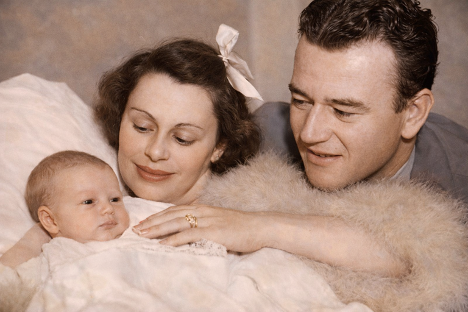
- Merle Oberon: An affair that reportedly stretched over two of Wayne’s marriages.7
- Esperanza “Chata” Baur: Initially his mistress during his first marriage, her own tumultuous temper and drinking eventually led to a divorce that “aired their dirty wash” in public.3
- Pilar Palette: His third wife, who became pregnant while he was still legally married to Chata. Fearing a scandal would ruin his career, Wayne reportedly persuaded her to have an abortion.3
- Pat Stacy: In his final years, Wayne lived with his secretary, Pat Stacy, a romantic involvement that was kept mostly away from the press.6
The contrast between Wayne’s “Moral Republican Warrior” image and his personal failings created a duality that fans continue to pick apart.12 While he crusaded for traditional American morality, his private life was often a source of instability for himself and those close to him.3
Behind The Scenes: Stories You Didn’t See On Screen
Away from the scripted heroics, John Wayne’s interactions with his female costars revealed a man of significant professional complexity. He was often described as a “re-actor” rather than a traditional actor, believing that “behaving truthfully under imaginary circumstances” was the key to a good performance.10 This philosophy made him a generous partner for those he respected but a demanding presence for those he felt were not dedicated to the work.2
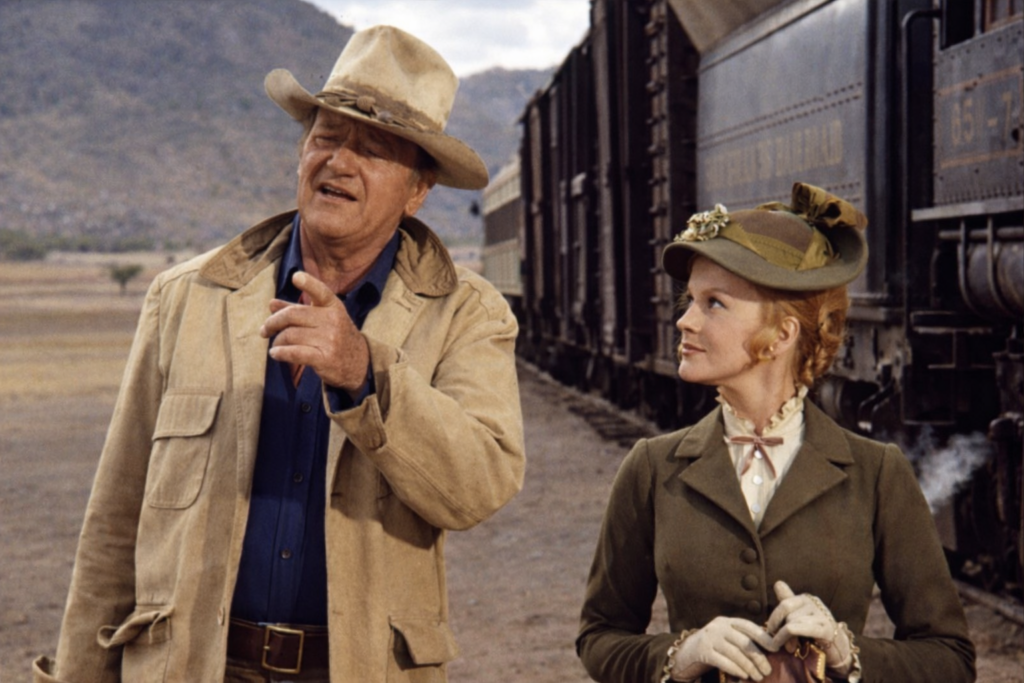
Ann-Margret shared one of the most touching accounts of Wayne’s kindness. During the filming of The Train Robbers (1973), she was “deathly afraid” of the horses she was required to ride.36 Wayne, noticing her shaking hands during a midnight shoot, offered her mineral water and calm encouragement, a gesture that began a lifelong friendship.36 He later lent his private plane to her and Ben Johnson when transportation from Mexico to Hollywood was difficult during Oscar season.36 He even once filled in as a guest for her on The Tonight Show when she was too ill to appear.36
However, the Duke could also be “very tough” on people.36 Katharine Ross, who played his daughter in Hellfighters (1968), recalled that Wayne “nailed” her after she gave an interview expressing a desire to do “better things” than the Westerns he was known for.36 Wayne valued loyalty to the craft and the production above all else, and any perceived slight to the work was met with his legendary temper.36
On-Set Anecdotes and Dynamics
| Actress | Event/Interaction | Wayne’s Behind-the-Scenes Behavior |
| Ann-Margret | Fear of horses on The Train Robbers | Provided mineral water and gentle encouragement; remained close friends. 36 |
| Jennifer O’Neill | Filming Rio Lobo | Offered career advice (“hearing it for the first time”); struggled physically to carry her after cancer surgery. 36 |
| Susan Hayward | Production of The Conqueror | Remained professional despite Hayward’s “drunken advances” and his wife’s presence on set. 38 |
| Katharine Ross | Wardrobe tests for Hellfighters | Confronted her about disparaging comments she made in Life Magazine. 36 |
| Angie Dickinson | Kissing scene in Rio Bravo | Expressed discomfort with the age gap, fearing it was “inappropriate.” 39 |
| Vera Miles | Working on John Ford sets | Described how Wayne made women feel “grateful” and validated their femininity. 20 |
One of the most tragic behind-the-scenes stories involves the production of The Conqueror (1956). Filmed near a nuclear test site in Utah, the production was riddled with disasters, including flash floods and a panther attack on Susan Hayward.38 Years later, a significant number of the cast and crew, including Wayne and Hayward, succumbed to cancer, leading many to label it “the film that killed John Wayne”.38 Despite the artistic failure of the film, Wayne and Hayward maintained a respectful working relationship throughout the grueling shoot.40
The Legacy of His Leading Ladies
The women who starred alongside John Wayne did more than just provide a romantic interest; they were integral to the longevity and cultural reach of his career. As Wayne aged, his leading ladies helped him transition from the “virile swagger” of his youth to the “nuanced, flawed” presence of his final years.29 By the middle and late phases of his career, he was often cast against women half his age, such as Angie Dickinson or Elsa Martinelli, which helped maintain his status as a viable box-office draw even as his physical health declined.1
More importantly, these women helped humanize a character that could have easily become a monolithic caricature. The “heroic levels of loyalty and resolve” displayed by actresses like Joanne Dru or Lauren Bacall mirrored the values Wayne’s characters were supposed to uphold.15 In his final film, The Shootist, the presence of Lauren Bacall as a widowed mother provided the emotional gravity for Wayne’s farewell to the screen.4 Their relationship in the film, one of “two withdrawn adults who have lived hard, tragic lives” offered a dignified conclusion to the John Wayne legend.4
Why These Stories Still Fascinate Fans Today
The enduring appeal of the “John Wayne and his ladies” narrative lies in the intersection of cinema, emotion, and private mystery. For many fans, the films are inseparable from the “John Wayne Values”, patriotism, family, and respect that he was seen to embody.24 The leading ladies are viewed as the guardians of these values, the only ones capable of challenging the Duke to be his best self.5
The combination of cinema and real-life emotion creates a compelling narrative for audiences who want to explore “behind the lights”.9 The mystery of his relationship with Maureen O’Hara, the tragedy of Gail Russell, and the sophistication of Marlene Dietrich provide a depth to his biography that his on-screen persona often obscured. These women were not just costars; they were part of a collective effort to build a myth that has survived for nearly a century.2
Conclusion: A Legacy Built on Shared Strength
John Wayne was the undisputed “King of the Western,” but his reign was supported by a succession of “Duchesses” who were his equal in every professional sense. His leading ladies were the “steel magnolias” and “titan matches” that defined the contours of his cinematic legacy.5 Whether they were his rumored lovers, his bitter enemies, or his most loyal friends, these women provided the necessary tension that made the Duke’s stories believable and his heroics meaningful.3
From the “electric” chemistry with Maureen O’Hara to the “palpable restraint” of his work with Lauren Bacall, Wayne’s career was a testament to the power of the partner.4 As long as audiences continue to seek out “what it looks like when two people on screen are genuinely unmistakably matched,” the stories of John Wayne and the women who stood beside him will continue to captivate the public imagination.5 His legacy was not built by one man alone, but by a series of extraordinary women who refused to be overshadowed by a legend.1