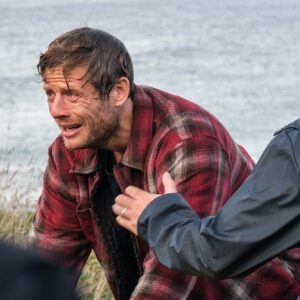
The rain didn’t just fall; it attacked. It hit with a violence that felt personal, blurring the line between the gray sky and the muddy gully of the Montana Highlands. Eighteen years old and flat on my back, I lay there with one hand pressed firmly against my ribs, feeling the warm, rhythmic pulse of blood escaping my body. Around me, twelve soldiers stood in a silent circle, their eyes vacant, watching me bleed as if I had already been processed into a piece of administrative paperwork.
“Liabilities don’t get rescue.”
The voice belonged to Sergeant Dale Morrow. He didn’t just speak the words; he punctuated them by driving his boot into my wounded side. The pain was a white-hot flash that eclipsed the cold. Morrow crouched, his fingers tangling in my hair to yank my head upward, forcing me to look into eyes that held no empathy—only a cold, calculated disdain. “You’re slowing us down, Carter,” he spat.
The Architecture of Betrayal
The betrayal wasn’t just in the boot or the words; it was in the silence of the others. Only a week prior, these men had been my comrades. We had shared burned mess-hall coffee and laughed over a box of Krispy Kreme donuts that someone had driven two hours to procure. Now, that camaraderie had evaporated. They stared past me, treating my presence like a traffic cone—an obstacle to be bypassed rather than a human being to be saved. In the background, Lieutenant Hargrove stood under the shelter of his poncho, dry and detached, his hand resting on his radio. To him, this wasn’t a crisis of morality or an act of attempted murder; it was merely an unfortunate weather delay.
Morrow leaned in closer, his breath smelling of stale tobacco and arrogance. “Do yourself a favor,” he whispered. “Stop trying so hard.”
The Calculus of Survival
That was Morrow’s fundamental mistake. He believed that survival was a product of strength, a contest of who could exert the most will over another. But as I lay in the mud, tasting copper and rainwater, I realized that survival isn’t about strength. Survival is accounting.
I began to run the ledger in my head. What do I have? What do I need? What can I lose without dying?
Morrow began his inventory of my losses. He took my rifle. He took my primary radio. He stripped away my team. But in his haste to discard the “liability,” he overlooked the details. He didn’t take my sidearm. He didn’t notice the cracked personal comm clipped securely inside my vest. And most importantly, he didn’t take my hearing.
Morrow stood up, wiping the mud from his gloves with a look of mild annoyance, as if my agony had been a slight inconvenience to his schedule. Then, without a backward glance, he turned away, leaving me to the rain and the silence.